Looking an expert team?  +91-74286 23211
+91-74286 23211  sales@semreseller.com
  Mon-Fri 9:30 - 6:30
+91-74286 23211 sales@semreseller.com Mon-Fri 9:30 - 6:30
Mon-Fri 9:30 - 6:30
+91-74286 23211 sales@semreseller.com Mon-Fri 9:30 - 6:30 If you want to know what Google does with your feedback from search results, you are in the right place. Like you, for years, many want to correct any issues on the Google search. Especially for those having eCommerce sites and with products to sell, it is one thing they badly want to know. But with 5.6 billion searches per day which is over two-thirds of the population, it is difficult to take action on the millions of feedbacks every day.

Image courtesy: in.pinterest.com
John Mueller, Google's webmaster trend analyst, recently gave some insights into what Google does with the enormous feedback. On the July 27 episode of #AskGooglebot, Mueller explains how Google receives, reviews, and prioritizes the feedback from Google search to make it easier for all. He says that for most of the feedback for issues with search results, Google corrects them algorithmically. Check out how to send feedback on search results to Google and what Google does from its own words.
Google controls over 92% of the search engine market worldwide. It is not simple work handling millions of feedbacks. Though Google never shares its search volume data, many experts estimate it to be approximately 63,000 searches every second, which is over a trillion searches every year globally. Regardless of what they do, most people will undoubtedly use Google search at one point or other in their life.
Since Google is a free powerhouse for information serving billions, it keeps most of its work not known to them. And many like you may want to send feedback on many issues and only wait for Google to respond. But no one knows precisely when and how Google will respond to the queries rising from the hundreds of billions of its web pages. But it takes all effort possible to index all the content regularly even though it is an arduous task. So now we can know a few things about what Google does with the feedback and how to send it.
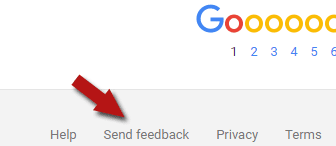
Image courtesy: Google
The most direct way to send feedback on the search quality is to use the so 'send feedback link. It is at the bottom of billions of search pages, and those sent by it will directly go to the Google team that reviews, organizes, and prioritizes it. In addition, Mueller recommends all to use the Google Search Central help forums. The community of search experts in these forums will be available for help and discuss it with Google depending on the need.

Image courtesy: developers.com
If you face anything incorrect, objectionable, or problematic, you can forward that to the public-facing Google accounts on Twitter and other social media sites. Mueller says that it will be helpful to know the query that produced unsatisfactory results for those sending feedback from search results. He wants to provide a minimum of one common question that many like you might use and highlight the issue. Make it easy for Google to recognize its scope and scale irrespective of the contact method.
Mueller further confirms that it makes little sense to tweak manually search results if there majority of problems and most of them get corrected algorithmically.
To a specific question on the eligibility of user feedback for Google deciding to tweak its search ranking algorithm, Mueller says it gets handled internally. He further adds that the web is ever-changing, and it is so gigantic that people ask questions daily. Hence, Google's aim is for improving the algorithms and not to tweak individual queries. The algorithms pull together all the search results, and though taking time will make the search better for all worldwide every day.
Mueller concludes by saying that Google is trying to prioritize all issues reported as feedback from search results in many ways. But some of it needs to work as soon as possible. In contrast, others need to wait until Google focuses on the specific system part again. Based on the submitted feedback, Google organizes issues that need urgent attention for its team to fix immediately manually.
The above facts on how Google handles the feedback from search results, as explained by Mueller, will surely help you.


Digital Marketing Specialist at SEMReseller

Have you once thought about how precisely Google could determine the information you were seeking even if your search was somewhat unclear or used non-standard words? It almost feels like the search engine is tapping into your thoughts!

The secret of getting a good position on Google does not only involve great content. You may have the best post but if it is hosted on a slow-loading server, it will not get traffic from Google searches, nor will any user wait for it to load.

Business successes rely on conversions no matter what stage of operation your company currently has. Your upgrading techniques for conversions can boost your ability to capture target clients.

Have you ever had the feeling that your website is the world's largest library hidden? Amazing content has been written, a stunning site has been designed, and you know very well that the information is needed by people. But when you do a Google search for it, it's not there. Annoying, isn't it?

Everybody is familiar with the traditional game of SEO (Search Engine Optimization). First, you do keyword research, then write a post, create some backlinks, and finally pray that Google becomes aware of your existence. It seems like a drive with a map and hoping you wouldn't get missed at any point.

As soon as a Google user clicks to your website a clock starts to tick. If your site is slow or the text keeps moving while the user is reading or the button response at the other end is slow, then the user leaves your site. A single, irritated pressing of the "back" button means you lose traffic, interaction, and possibly even sales.

When you type a question into Google and hit Enter, you're talking to one of the world's smartest computer programs. These computer programs are called search engine algorithms, and they are the secret formula for discovering the most suitable answer out of billions of web pages.

The "Graphic Design is My Passion" meme is a funny internet joke about bad design. It started making fun of poorly designed graphics, but over time, it expanded a lot. People use this meme to joke about cringy, messy, or strange designs. The phrase reads confidently, but when combined with a terrible design, it creates a funny comparison. The meme started on Tumblr in 2014, showing a poorly drawn green frog and ugly text. It has expanded since then, inspiring many copies on the internet.

AI presents an undeniable transformation for the future of SEO by programming routine tasks. It enables researchers to boost keyword analysis and improve content efforts and performance evaluation. Yet, people continue to be essential for interpreting user needs and producing high-quality materials.

The mark of business is always that content marketing remains an ever-changing turf. Keeping track of the trends has to be a crucial factor in ensuring that customers can learn a competitive edge over other businesses. 2026 opens up multiple years for trends emerging forth in creating a new future for content marketing worldwide. For instance, this includes AI personalisation, as well as video and interactive elements.
Your email address will not be published.
Required fields are marked *
 +91-74286 23211